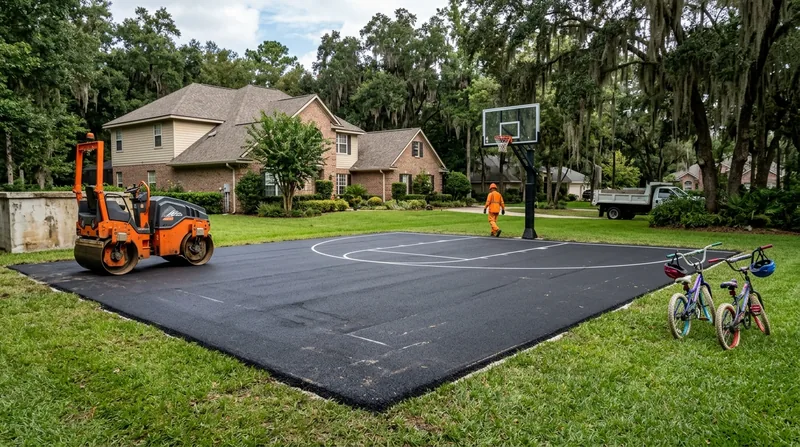




Sports Court & Path Paving in Gainesville means building a dead-flat, structurally sound asphalt base for basketball courts, tennis and pickleball surfaces, walking paths, and golf cart trails that stay true through North Central Florida's heat, humidity, and afternoon thunderstorms. Gainesville's residential neighborhoods, from the historic Duckpond and Pleasant Street districts with their mature live oaks to the sprawling subdivisions of Haile Plantation and the southwest growth corridor, often have backyard courts and recreational paths that demand precision grading and tight-tolerance surface work. The sandy base over clay and limestone in this region, combined with summer storms that can dump inches in an hour and rare winter freezes, means the asphalt structure has to be built right the first time. We grade, compact, and pave courts and paths to acrylic-ready specifications so your surface performs for years without settling or cracking. Call us at (352) 450-6164 for a free estimate, or learn more about our parking lot and commercial paving work to see how we handle precision asphalt on larger scales.
Why Sports Court & Path Paving Matters in Gainesville
A backyard basketball court or a private walking path is an investment in property value and daily use, but it only works if the surface is flat, stable, and properly drained. In Gainesville, the combination of fine sand base, heavy summer rainfall, and root pressure from mature live oaks and laurel oaks means that amateur grading or thin asphalt fails fast. A court that settles or a path that puddles after rain becomes unusable and costly to fix. Professional paving starts with the right base preparation, proper compaction, and a surface course thick enough to handle Florida heat without rutting.
- We proof-roll and grade the subgrade to remove soft spots and ensure water flows away from the court surface.
- We compact a dense asphalt base that won't shift under the weight of play or heavy equipment.
- We finish with a tight-tolerance surface course ready for acrylic paint systems and court markings.
- We build drainage so the court sheds rain instead of pooling, extending the life of the acrylic finish.
A properly built court stays playable for 15 to 20 years with routine maintenance and resurfacing.
Key info: Gainesville's Haile Plantation and University Park neighborhoods have added dozens of residential courts and paths in the past decade. Many of those early installations are now showing settlement or alligator cracking because the base was not compacted properly or the surface was too thin for Florida's heat and moisture. We build to last, which means taking the time to get the foundation right.
For more on how we approach commercial courts and larger recreational surfaces, see our parking lot paving service, which applies the same precision grading and compaction principles.
How We Build Sports Courts and Paths in Gainesville
Building a court or path starts with understanding the site: the existing grade, drainage patterns, tree roots, and the intended use. We walk the property, identify soft spots or areas where water collects, and plan a grading strategy that slopes the surface away from structures and toward drainage. In Gainesville, where afternoon thunderstorms and tropical systems like Idalia and Helene can deliver 4 to 6 inches in a few hours, slope and base stability are not optional.
- We clear the site and excavate to remove organics, roots, and soft clay layers that won't support asphalt.
- We import compacted Ocala-area limerock or recycled asphalt base material and build a stable subgrade.
- We proof-roll the base with heavy equipment to identify and correct soft spots before asphalt goes down.
- We set grades and slopes so water drains cleanly away from the court surface and toward swales or storm drains.
- We lay a dense binder course and a tight-tolerance surface course, finished dead-flat for acrylic systems.
- We allow the asphalt to cure for 24 to 48 hours before play or painting begins.
The result is a court that plays true and a path that won't settle or crack under Florida's heat and moisture cycles.
Local example: A customer in Newberry wanted to add a tennis court and a cart path to their property. The site had live oak roots near the surface and a seasonal seep that made the ground soft in summer. We excavated the root zone, brought in 18 inches of compacted base, and built the court and path with a 2 percent slope toward a drainage swale. The court has been in use for three years with no settlement or cracking, and the path handles the heaviest rains without pooling.
For details on how we handle drainage and base prep on a larger scale, see our gravel driveway and grading service, which covers the same principles.
Methods and Approaches for Court and Path Paving
| Approach | Description | Best for |
|---|---|---|
| Full Depth Build | Excavate to subgrade, compact limerock base, build 3 to 4 inches of asphalt with tight surface tolerance. | New courts, paths on soft or poor-draining sites, projects with root interference or settlement risk. |
| Overlay on Existing Base | Mill or grind the old surface, proof-roll the base, and lay a new surface course if the base is sound. | Existing courts or paths with good base but worn or cracked surface, budget-conscious resurfacing. |
| Recycled Asphalt Base with New Surface | Build base from recycled millings, compact thoroughly, and finish with virgin asphalt surface course. | Cost-conscious new builds, paths where appearance is less critical, base preparation on budget sites. |
| Grading and Drainage Only | Slope and compact the site, install swales or drainage structures, defer asphalt to a later phase. | Phased projects, sites with major drainage problems, preparation for future court or path addition. |
Sports Court and Path Paving Cost in Gainesville: What to Expect
The cost of a backyard court or path depends on size, site conditions, and the depth of base preparation required. A new basketball court typically runs from $8,500 to $14,000, a tennis court from $12,000 to $18,000, and a walking path from $4,500 to $9,000, depending on length and width. These figures assume a standard residential lot with reasonable access and no major drainage or root issues. If the site has soft ground, tree roots, or poor drainage, base preparation costs rise. If the existing asphalt is sound and you are overlaying, costs drop significantly.
The biggest cost drivers are excavation and base compaction, especially in Gainesville where sandy soil over clay and limestone requires careful grading. A site with mature live oaks may need root mitigation or deeper excavation around the trunk zone. Storm drainage or swale work adds to the ticket. The surface course itself, once the base is solid, is a smaller piece of the budget.
We recommend getting a free written estimate that includes site photos, measurements, and a breakdown of base work, material, and finish. Two or three estimates help you understand what you are paying for and why prices differ. Call (352) 450-6164 to schedule a walk-through.
Sports Court and Path Paving Near Me: What Gainesville Homeowners Should Know
Hiring a paving contractor for a court or path is a significant decision, and the cheapest bid is often a red flag. Look for a company that is fully insured, provides a written estimate with material specifications and tonnage, and can show examples of similar work. In Gainesville, verify that the contractor is familiar with local soil conditions, drainage requirements, and any HOA or municipal rules that apply to your property. Many master-planned communities in Haile Plantation, Golfview, and other neighborhoods have architectural standards that govern materials and finishes.
- Ask for references from recent court or path projects and contact at least two to verify quality and timeline.
- Request a detailed estimate that breaks down excavation, base material, asphalt tonnage, and surface finish.
- Verify that the contractor carries general liability and property damage insurance and can provide a certificate.
- Check with your local building department to determine if a permit is required for court or path construction.
- Review any HOA architectural guidelines or deed restrictions that may apply to materials, colors, or surface treatments.
- Ask about curing time and when the court or path can be used after paving is complete, typically 24 to 48 hours for light use.
A contractor who takes time to understand your site, explains the work clearly, and provides a written contract with a timeline is more likely to deliver a court or path that performs and lasts. Contact us at (352) 450-6164 for a free estimate and to discuss your project.
Sports Court & Path Paving in Gainesville: Pricing Guide
| Service | Price | Details |
|---|---|---|
| Basketball court (2,500 sq ft) | Starting at $8,500 | Full-depth excavation, compacted limerock base, 3.5-inch asphalt, grading and drainage included |
| Tennis or pickleball court (2,700-3,200 sq ft) | Starting at $12,000 | Excavation, dense base, tight-tolerance surface course ready for acrylic paint, slope and drainage |
| Walking path or golf cart trail (per 100 linear feet) | Starting at $1,200 | Depends on width, site conditions, and base preparation; soft ground or tree roots increase cost |
| Site with root interference or poor drainage | On estimate | Root mitigation, swale work, or deeper base preparation requires site inspection to quote accurately |
| Overlay on existing sound base | Starting at $4,500 | Mill old surface, proof-roll, lay new asphalt finish course; saves money if base is structurally solid |
| Free estimate and site visit | Free | Measurements, photos, written breakdown of costs; response within 24 hours at (352) 450-6164 |
Indicative pricing, the exact cost depends on square footage, finish, and site access. Free personalized estimate within 24h at (352) 450-6164.


