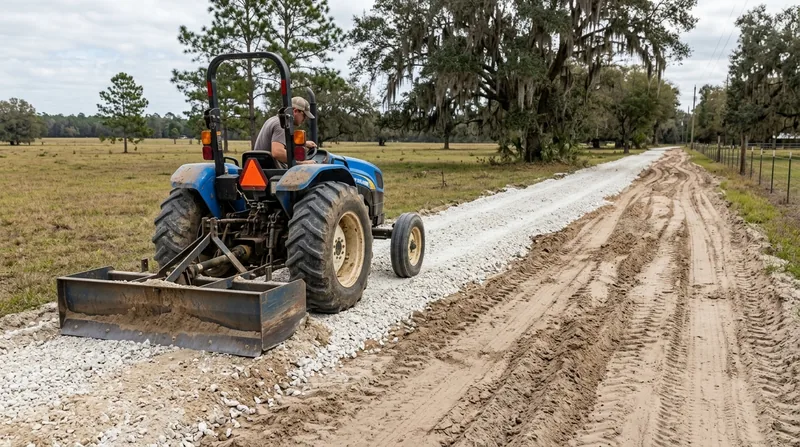




Gravel Driveway Installation & Grading in Gainesville is the foundation for every long-term paving project, and it is the most honest first step for rural properties and farm lanes across North Central Florida. Gainesville's sandy soil over clay and limestone bedrock demands proper base preparation, especially where summer thunderstorms wash out ungraded lanes and where the weight of tree canopy and root heave from live oaks and laurel oaks lift and crack every surface built on a weak base. Whether you own a property in the Duckpond or Pleasant Street historic districts with a short brick drive under century-old oaks, a 1960s ranch on the northwest side whose gravel lane has settled into ruts, a subdivision lot in Haile Plantation or the southwest growth corridor, or a horse farm or rural property toward Reddick or Archer with a shell and limerock drive that washes out every summer, the ground beneath matters more than what goes on top. We build gravel drives in proper lifts of compacted limerock or recycled crushed concrete over landscape fabric, crown them for drainage, and fill washout potholes on lanes that the afternoon storms have carved into the land. Good grading is also the first step of every future asphalt paving job, and we build the base once and correctly over this sand so that when you are ready to move to asphalt driveway paving, the work holds for years.
Why Gravel Driveway Grading and Base Prep Matter in Gainesville's Sandy Terrain
Gainesville sits on fine sand over clay and limestone riddled with karst features, and this ground moves. Summer thunderstorms deliver more than 48 inches of rain in concentrated bursts, tropical systems like Idalia and Helene wash out drive edges and soften uncompacted bases, and the weight of water percolating through sand without proper crown or drainage turns a solid lane into a rutted bog within weeks. Tree roots from the live oaks and laurel oaks that shade every historic lot and many newer homes heave from below, lifting pavement and gravel alike. Winter freezes are rare, but when they come, they crack asphalt that was laid over a weak or shifting base. A gravel drive built without proper lift, compaction, and fabric fails within a season. An asphalt drive built on an inadequate base fails within three to five years, no matter how thick the asphalt is. The money spent on grading now is the money you do not spend on replacing the drive later.
- We compact limerock or recycled crushed concrete in proper lifts to create a stable base that sheds water and resists settlement.
- We crown the drive so that water runs off to the sides and does not sit in the center where it softens the base.
- We install landscape fabric between the base and the top course to prevent fine sand from migrating up into the gravel and creating a mud layer.
- We fill washout potholes and ruts on existing lanes and regrade the entire surface so that the drive functions as a drive and not a drainage channel.
- We verify that water flows away from structures, culverts, and property lines, and we work with the local grading requirements set by the Gainesville municipal code and the Alachua County building department.
Proper grading is the difference between a drive that lasts five years and one that lasts twenty.
Local example: A ranch home on the northwest side of Gainesville with a 1960s gravel drive under a 60-foot live oak had settled into deep ruts where the tree roots had heaved the center. We regraded the entire 80-foot lane, filled the high spots and the root heave, crowned it for drainage, and laid fresh limerock. The homeowner then had the option to pave or to maintain the gravel. The regrading cost $1,200 and bought time for a decision.
How We Install Gravel Driveways and Regrade Lanes in Gainesville
Every gravel job starts with an on-site look at the soil, the drainage pattern, the slope, the trees, and what has failed in the past. We measure the drive, determine the lift and tonnage needed, and quote you the cost before we begin. On the day of work, we bring in the equipment, remove any failed or sunken gravel, proof-roll the base to find soft spots, add limerock or recycled crushed concrete in lifts of 3 to 4 inches, compact each lift with a plate compactor or roller, and top it with a final course of washed limerock or a mix of crushed stone and dust that locks together. We crown the drive by hand or with the grader blade so that the center is 1 to 2 inches higher than the edges. We also install landscape fabric under the top course to prevent the sand below from working up into the gravel. The whole job typically takes one day for a 100-foot residential drive, and the drive is ready to use immediately.
- We assess the existing grade, identify soft spots or washout areas, and measure the entire drive or lane.
- We remove failed or sunken gravel down to solid base, and we haul it away or recycle it on site if it is clean.
- We compact the subgrade with a plate compactor or roller to remove air and create a stable platform.
- We lay landscape fabric over the compacted base to prevent sand migration up into the gravel.
- We add limerock or recycled crushed concrete in 3 to 4-inch lifts, compacting each lift before adding the next.
- We crown the drive by hand or with the grader blade so that water sheds to the sides.
- We top with a final course of washed limerock, stone dust, or a mix that locks together and does not track onto your lawn or the street.
The entire process is straightforward and honest, and the result is a drive that drains, does not rut, and will support asphalt paving when you are ready to make that move.
Newberry example: A farm property near Newberry with a 250-foot shell and limerock lane had washed out in the summer storms two years running. We regraded the entire lane with a grader, added 8 inches of compacted limerock, crowned it, and installed fabric under the top course. The cost was $2,100. The property owner has had no washout since, and the lane is now a candidate for tar and chip or light asphalt paving if the budget allows.
Gravel Driveway Installation & Grading Methods and Materials
| Approach | Description | Best for |
|---|---|---|
| Limerock Base | Compacted layers of crushed limestone from Ocala-area quarries, the standard for Gainesville's sandy soil. Locks together, resists settlement, and sheds water. | Residential driveways, farm lanes, private roads. Durable for 5 to 10 years with maintenance. |
| Recycled Crushed Concrete | Reclaimed concrete from demolition, crushed to 1.5 inches and smaller, compacted in lifts. Performs like limerock and costs less. | Budget-conscious jobs, environmental preference, properties where limerock is not available. |
| Crown and Regrade | Reworking an existing gravel drive with a grader blade to establish proper slope, fill ruts and washout potholes, and recompact the surface. | Existing lanes that have settled or washed out. Extends life by 3 to 5 years if done before the base is gone. |
| Landscape Fabric Installation | Geotextile fabric laid between the subgrade and the top course of gravel to prevent sand from migrating up and creating a mud layer. | Any new gravel installation or major regrading. Increases durability and reduces maintenance. |
Gravel Driveway Installation & Grading Cost in Gainesville: What to Expect
A new gravel driveway in Gainesville starts at around $950 for a 100-foot residential drive, which includes removal of failed material, compacted limerock base in proper lifts, landscape fabric, and a finished top course. The price moves up based on the length of the drive, the width (residential is typically 12 to 16 feet, but farm lanes run 16 to 20 feet or wider), the depth of failed base that needs replacement, the presence of tree roots that must be worked around, and the distance from the property to the quarry or recycling facility where we source the material. A regrading job on an existing lane with no removal typically costs less than a full rebuild. A 250-foot farm lane with washout damage and heavy root heave can run $1,800 to $2,500. Recycled crushed concrete is usually 15 to 25 percent cheaper than limerock and performs equally well on Gainesville's sandy soil. We provide a written estimate with tonnage and lift specifications before any work begins, and we include travel to Gainesville and the surrounding areas at no extra charge. For a detailed breakdown and to see how your specific drive is priced, visit our pricing page or call (352) 450-6164 for a free estimate.
Gravel Driveway Installation & Grading Near Me: What Gainesville Homeowners Should Know When Hiring
Hiring a contractor for gravel work is straightforward if you know what to look for. Start by asking any contractor whether they are fully insured and can provide a certificate of insurance upon request. Ask to see a written estimate that includes the length and width of the drive, the depth and type of material, the tonnage, and the number of lifts. Ask for references from recent jobs in Gainesville or nearby towns like Alachua, High Springs, or Newberry. If your property is in an HOA community like Haile Plantation or one of the southwest growth corridor subdivisions, verify the architectural standards for driveway material and color before you commit, because some HOAs restrict gravel to temporary use and require paving within a set time. If your drive is near the road, check whether the city or county requires a permit for driveway work, culvert work, or curb cuts. Most of Gainesville requires permits for work that affects the right-of-way or drainage, and you can verify this by calling the Gainesville Public Works Department or the Alachua County building department. Never hire a contractor who shows up unsolicited, quotes a price over the phone with no site visit, or asks for a large cash deposit before starting. Get at least two or three estimates so you understand the range. Call us for a free estimate at (352) 450-6164, and we will walk you through the process and answer any questions about permits or HOA requirements in your specific neighborhood.
Gravel Driveway Installation & Grading in Gainesville: Pricing Guide
| Service | Price | Details |
|---|---|---|
| Residential Gravel Driveway (100 feet, 12-16 feet wide) | Starting at $950 | Removal of failed material, compacted limerock base, landscape fabric, finished top course, includes travel |
| Regrading and Crown Existing Lane (no full removal) | Starting at $650 | Grading blade work, fill ruts and washout potholes, recompact surface, extends life 3 to 5 years |
| Farm Lane or Private Road Rebuild (200-300 feet) | Starting at $1,800 | Full removal and base replacement, multiple lifts, proper crown, handles tree roots and heavy washout damage |
| Recycled Crushed Concrete Base (alternative to limerock) | 15-25% less than limerock | Equal performance on Gainesville sand, environmentally preferred, sourced from local demolition and recycling |
| Complex or Large-Scale Job (over 300 feet, heavy root heave, drainage work) | On estimate | Site visit required to assess soil condition, drainage pattern, tree interference, and scope before pricing |
| Free Estimate | No charge, no obligation | Written estimate with tonnage and lift specs, response within 24 hours at (352) 450-6164 |
Indicative pricing, the exact cost depends on square footage, finish, and site access. Free personalized estimate within 24h at (352) 450-6164.


