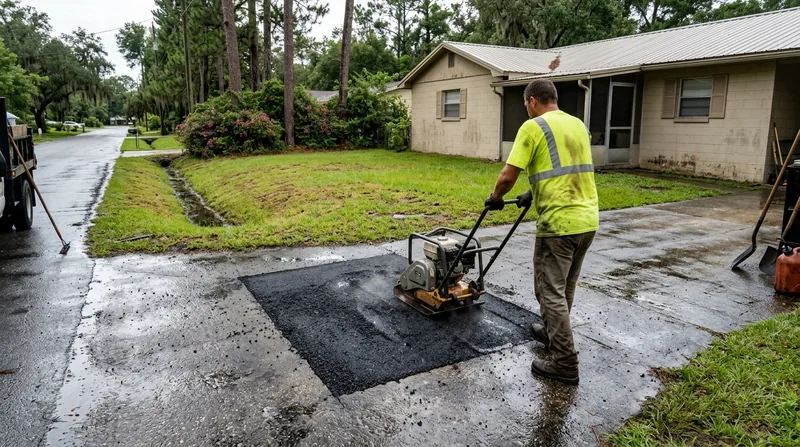




Pothole Repair & Asphalt Patching in Gainesville is a year-round necessity in North Central Florida, where summer thunderstorms and tropical systems like Idalia and Helene open holes fast and turn standing water into failing sections. Gainesville's sandy base over clay and limestone means potholes spread quickly once the surface breaks, and the dense tree canopy from live oaks and laurel oaks across the Duckpond, Pleasant Street, University Park, and the northwest Millhopper blocks compounds the damage as roots heave and shade prevents proper curing. We cut potholes square, tack-coat the sides and base, and fill them with compacted hot mix. We also run infrared patching that recycles the surface in place for seamless repairs with no waiting. One hole caught early saves you from a failed section, so we book quick assessments and get the work done before the next downpour.
Why Pothole Repair Matters in Gainesville's Climate and Terrain
Gainesville sits on fine sand over clay layers and limestone riddled with karst sinkholes, a foundation that sheds water poorly and softens under heavy rain. The Alachua County building stock ranges from 1880s Victorians with short, shaded drives to 1960s-80s brick ranches to the 1990s-2020s subdivision boom on the southwest side and in Haile Plantation, and nearly every driveway is aging out together. More than 48 inches of rain arrive in summer thunderstorms and tropical systems that wash out edges and soften bases. When standing water pools after a downpour, it forces its way into tiny cracks in the asphalt, seeps into the base, and the next car or truck load breaks the surface into a pothole. Left alone, one pothole becomes two, then a failed section that costs far more to repair.
- Standing water after heavy rain opens potholes fast because the sandy base cannot drain quickly enough.
- Tree roots from live oaks and laurel oaks lift and crack asphalt, creating entry points for water.
- Tropical systems and summer thunderstorms deposit 2 to 4 inches of rain in hours, overwhelming drainage.
- Catching and patching one hole before it spreads saves the base and keeps repair costs down.
Early repair is the difference between a pothole and a section failure.
Key info: In Gainesville and Alachua, potholes are most common from June through September when afternoon thunderstorms are daily and the base is saturated. Spring potholes (March to May) often appear after winter rains have softened the base and tree roots have heaved the surface. Quick repair in these seasons prevents expensive base work later. Call (352) 450-6164 for a free assessment after heavy rain.
See also: Driveway Repair in Gainesville for the full range of surface and base issues.
How We Repair Potholes and Patch Asphalt in Gainesville
Our crew uses two proven methods depending on the pothole size and location. For isolated holes, we cut the damaged area square, clean out loose material and standing water, tack-coat the sides and base with sticky bonding agent, and fill with compacted hot mix asphalt rolled to match the surrounding surface. For larger sections or where seamless blending is critical, we use infrared heating to recycle the existing asphalt in place, eliminating waiting time and the visible seam that square patches can leave. Both methods start with a free on-site assessment so you know the scope and cost before we begin.
- We measure the pothole and probe the base to check for soft spots or failed foundation.
- We cut the damaged area square or remove the top layer if infrared patching is the better choice.
- We clean out all loose material, standing water, and debris down to solid base.
- We apply tack coat to bond the new asphalt to the sides and base of the hole.
- We fill with compacted hot mix, rolled and leveled flush with the surrounding pavement.
- We allow the patch to cool and cure before traffic resumes, typically 2 to 4 hours in warm weather.
The entire job from arrival to traffic-ready usually takes 1 to 3 hours depending on pothole count and size.
Local example: A property on Archer Road near the retail corridor had three potholes open up after Tropical Storm Idalia. We assessed all three, patched two with square cuts, and used infrared for the largest one near the apron where a visible seam would have been noticeable. Total time on site was 2.5 hours, and the drive was ready for use the same day. Cost was within the standard range for three potholes on a commercial drive.
Learn more about larger repairs: Asphalt Resurfacing & Overlay in Gainesville if the pothole is part of a larger failing section.
Pothole Repair and Asphalt Patching Methods
| Approach | Description | Best for |
|---|---|---|
| Square-Cut Patch | Cut the damaged area into a square or rectangle, remove loose material, tack-coat, and fill with compacted hot mix asphalt. | Small to medium potholes, isolated damage, parking lots where visibility of the repair is acceptable. |
| Infrared Patching | Heat the surrounding asphalt with infrared equipment, blend new material into the heated zone, and roll seamless. No waiting for cure. | Larger potholes, driveways where seamless finish is desired, high-traffic areas, residential aprons. |
| Multiple Potholes | Assess all holes, prioritize by severity, use square cuts or infrared depending on size and location, and repair in one visit. | Driveways or parking lots with scattered damage after heavy rain or tropical system. |
| Base Repair | If the base is soft or failed, we remove the pothole area to firm base, compact new limerock, and patch the surface above. | Potholes that recur, or holes that probe soft underneath, indicating base failure. |
Pothole Repair & Asphalt Patching Cost in Gainesville: What to Expect
Most single potholes in Gainesville run from $450 to $800 depending on size, depth, and whether the base is solid or soft. A small pothole on a residential drive costs less than a large one on a parking lot or a hole that requires base repair. Multiple potholes are discounted per hole, so a drive with three holes will cost less per hole than one isolated repair. We provide a free on-site estimate with specific measurements and tonnage specs so you know the exact scope and cost before we start.
Factors that move the price include pothole diameter and depth, whether the base is firm or soft and requires limerock, the location (residential drive, parking lot, apron), and whether we use square-cut or infrared patching. A 12-inch pothole on a residential drive with a solid base is less expensive than a 24-inch hole on a parking lot where the base has softened. If we find soft base material, we remove it to firm ground, compact new limerock, and patch over, which adds material and labor. Getting 2 or 3 estimates from different contractors is always smart so you can compare scope, method, and price.
See our full pricing overview for ranges on single and multiple patches, and call (352) 450-6164 for a free estimate with no obligation to book.
Pothole Repair & Asphalt Patching Near Me: What Gainesville Homeowners Should Know When Hiring
Paving is a local trade, and the strongest trust signal is a contractor with a local address, local plates, and a verifiable history in your county. Avoid unsolicited door-to-door offers, crews with out-of-state plates, and prices that are too good to be true. A legitimate contractor will give you a written estimate with the pothole size, repair method, and tonnage or square footage, and will explain why one approach costs more than another. Ask for references from recent work in Gainesville or nearby areas like Alachua, High Springs, or Newberry, and call them to confirm the work was done on time and held up.
Gainesville and Alachua County do not require a state contractor license for driveway paving, but the city or county may require a permit for apron work, culvert work, or anything touching the right-of-way. Before you hire, verify with the Gainesville Building Department or your city or village whether a permit is needed for your pothole repair or patch. If you are in an HOA like Haile Plantation or a master-planned community, check your architectural guidelines to confirm asphalt repair is permitted and follows any color or material standards. We help you navigate local permitting and can discuss your specific site before you book.
Call us at (352) 450-6164 for a free, no-obligation estimate, or visit our contact page to request an assessment. We are fully insured and have been serving Gainesville and North Central Florida since 2011.
Pothole Repair & Asphalt Patching in Gainesville: Pricing Guide
| Service | Price | Details |
|---|---|---|
| Single small pothole | Starting at $450 | Pothole up to 12 inches diameter with solid base, square-cut and patched with compacted hot mix asphalt |
| Single large pothole or infrared patch | Starting at $650 | Pothole 12 to 24 inches diameter or seamless infrared blending, firm or slightly soft base, labor and material |
| Multiple potholes | Starting at $400 per hole | Three or more potholes on same driveway or lot, discounted per-hole rate, assessed and repaired in one visit |
| Pothole with base repair | On estimate | Soft or failed base requires removal to firm ground, new limerock, compaction, and surface patch, quoted on site |
| Travel | Included | No separate call-out or mileage fee in Gainesville and surrounding service areas |
| Free estimate | No obligation | On-site assessment with measurements and written scope, response within 24 hours at (352) 450-6164 |
Indicative pricing, the exact cost depends on square footage, finish, and site access. Free personalized estimate within 24h at (352) 450-6164.


