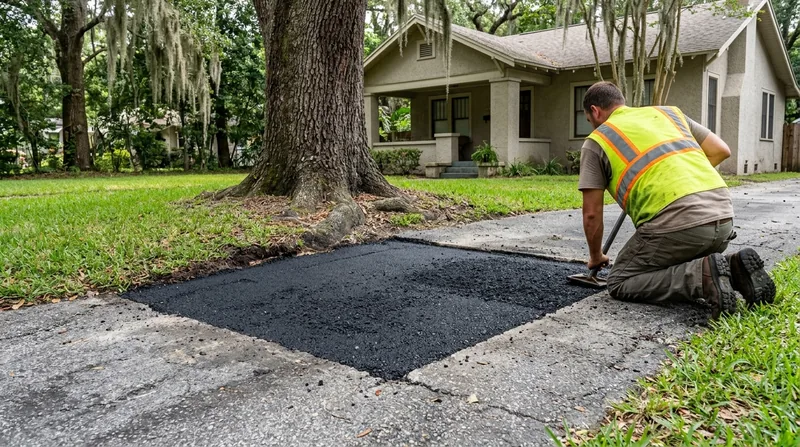




Driveway Repair in Gainesville means fixing sunken aprons, crumbling edges, and asphalt sections cracked by live oak roots or washed out by summer storm surge before they spread into the base. The Duckpond, Pleasant Street, and Southeast Historic District neighborhoods sit on 1880s-1920s properties with short drives under massive live oaks whose root systems heave pavement from below; University Park and Golfview run similar old stock with the same problem at scale. The northwest ranches from Millhopper onward are decades past their surface life, and the newer subdivisions in Haile Plantation and the southwest corridor are aging into their first major repairs. We patch full-depth, key into sound asphalt, and tell you honestly when a repair buys you years and when the money belongs in resurfacing instead.
Why Driveway Repair Matters in Gainesville: Understanding the Real Damage
North Central Florida's climate and terrain create three distinct failure patterns. Summer thunderstorms and tropical systems like Idalia and Helene dump 48 inches of rain annually, and that water finds the edges of driveways and softens the base layer below the asphalt surface. Simultaneously, the massive live oaks and laurel oaks that shade every historic neighborhood push roots upward under the pavement, cracking and heaving it from underneath. Winter freezes are rare but real, and they crack asphalt that is already weakened. A single pothole or a section of alligator cracking left unrepaired will spread into the base within one season, and then the repair cost doubles.
- Storm-washed edges and subsurface voids require full-depth patching that removes failed material down to solid base and replaces it with new asphalt keyed into the surrounding sound pavement.
- Root heave from live oaks creates localized cracking and settlement that spreads if not addressed before the next heavy rain season.
- Alligator cracking signals base failure and demands either full-depth patches at the worst spots or resurfacing across the entire drive.
- Sunken aprons and crumbling edges where the driveway meets the lawn invite water underneath and accelerate base deterioration.
Early repair prevents expensive replacement. The Gainesville building code and Alachua County permitting rules govern driveway aprons, culvert work, and right-of-way cuts, so verify requirements with your city or county before work begins. Visit the Pothole Repair & Asphalt Patching page for details on how we handle widespread damage across a drive.
Key info: A driveway in University Park or Golfview with root heave under a mature live oak may need full-depth patches at the worst spots rather than a full resurface. A drive in a Haile Plantation neighborhood showing alligator cracking across 30 percent of the surface likely needs resurfacing, not spot repair.
How We Repair Driveways in Gainesville: Step-by-Step Process
We start with a written site visit and measure the damage, assess the base condition by looking at the edges and any exposed sections, and determine whether the repair is localized or signals a wider problem. We give you a written estimate with tonnage, depth, and the square footage of the patch. We then schedule the work around afternoon thunderstorms and hurricane season, bring in the milling equipment if needed to remove failed asphalt, prep and compact the base, and install new asphalt to match the original surface. The entire process takes one to three days depending on patch size and base work required.
- We visit your property, measure the failed area, and assess whether the base is solid or compromised.
- We remove all failed asphalt and any soft or displaced base material down to firm ground.
- We compact the base with a vibratory roller and proof-roll it to confirm stability before new asphalt goes down.
- We install new asphalt in lifts, compact each layer, and feather the edges to blend with the existing surface.
- The repair cures for 24 to 48 hours before the drive is ready for normal use.
For larger jobs or drives with multiple problem areas, we may recommend asphalt resurfacing instead of scattered patches, which gives you a single smooth surface and better long-term value.
Example: A driveway in Archer with a sunken apron and three potholes caused by storm runoff and a weak base gets full-depth patches at each pothole, edge reconstruction along the apron, and compaction of the base. The repair takes two days, costs less than a full resurface, and holds for five to seven years if the base stays dry.
Driveway Repair Methods and When to Use Them
| Approach | Description | Best For |
|---|---|---|
| Full-Depth Patch | Remove failed asphalt and compromised base, compact new base, install new asphalt keyed into surrounding sound pavement. | Localized potholes, root heave, storm damage, and sunken aprons affecting less than 20 percent of the drive. |
| Skin Patch (Temporary) | Seal or fill a pothole without removing base material, temporary fix only. | Emergency temporary repair only; not recommended in Gainesville due to heavy rain and root pressure. |
| Asphalt Resurfacing | Mill off the top 1.5 to 2 inches of existing asphalt and install new overlay on the existing base. | Widespread cracking, alligator cracking across 20 to 40 percent of the surface, or multiple scattered potholes. |
| Full Replacement | Remove all asphalt and base, rebuild base from compacted limerock, install new asphalt. | Alligator cracking across more than 40 percent, failed base, severe settling, or a drive older than 25 years with multiple failures. |
We recommend the repair method that gives you the best value over the next five to ten years. If a drive shows alligator cracking across more than 30 to 40 percent of the surface, the base is likely compromised and patching will fail by the next storm season; resurfacing or replacement is the honest choice.
Driveway Repair Cost in Gainesville: What to Expect
A full-depth patch for a single pothole or a small sunken apron starts at $450 and covers removal, base prep, and new asphalt for up to 100 square feet. A larger patch covering 200 to 300 square feet runs $800 to $1,400 depending on the depth of base failure and whether tree roots are present. Multiple patches across a drive cost $1,500 to $3,500. A full resurface of a typical residential driveway (500 to 800 square feet) starts around $2,500 and moves higher if the base needs repair or if extensive milling is required. Full replacement of a 600-square-foot drive with new base and asphalt runs $4,500 to $7,000 or more. These figures reflect Gainesville market rates and assume standard residential access; rural drives near Archer or Hawthorne with long shell or limerock lanes may cost more due to distance and base preparation.
The factors that move cost up are the depth of base failure, the presence of tree roots that require careful removal, the age and condition of the surrounding asphalt, and whether the drive needs milling or full excavation. We provide a written estimate with square footage and tonnage before work begins. Get two or three estimates from local contractors so you understand the range and can compare the detail of each proposal. Visit our pricing page for a full breakdown of service rates.
Driveway Repair Near Me: What Gainesville Homeowners Should Know When Hiring a Contractor
A local paving contractor with a Gainesville address and local plates is the strongest trust signal in this business, because the historic fraud in driveway paving is the itinerant crew that shows up with unsolicited offers and "leftover asphalt from a job nearby." Verify that any contractor you hire carries liability insurance and can provide a certificate. Ask for written estimates from at least two contractors and compare the detail: a solid estimate includes the square footage of the repair, the depth of asphalt and base being installed, the tonnage of new material, and a completion timeline. Check references from recent jobs in your neighborhood. If your driveway is in a historic district or a master-planned community with HOA rules, verify that the materials and method comply with local architectural standards before you get estimates; some jurisdictions and HOAs restrict asphalt color or texture, or require approval for apron work.
- Verify that the contractor carries full liability insurance and can provide proof before work begins.
- Get written estimates with square footage, material specifications, and tonnage so you can compare fairly.
- Ask for references from driveways repaired in your neighborhood within the past two years.
- Confirm that any apron, culvert, or right-of-way work complies with Gainesville or Alachua County permitting rules.
- Check your HOA architectural guidelines if you live in Haile Plantation or another master-planned community.
- Avoid any contractor who asks for a large cash deposit before work begins or offers a price that seems too good to be true.
We are fully insured and have been in business since 2011. Call us at (352) 450-6164 for a free written estimate, or contact us online for a no-obligation site visit.
Driveway Repair in Gainesville: Pricing Guide
| Service | Price | Details |
|---|---|---|
| Single pothole or small patch | Starting at $450 | Full-depth repair up to 100 square feet, includes base prep and new asphalt installed and compacted |
| Medium patch or multiple small repairs | Starting at $850 | 200 to 300 square feet, multiple potholes, sunken apron, or root heave in one area, base assessment included |
| Large patch or scattered damage across drive | Starting at $1,800 | 400 to 600 square feet of full-depth repair, multiple problem areas, or extensive base work required before new asphalt |
| Full driveway resurface or replacement | On estimate | Depends on total square footage, base condition, milling required, and whether new base installation is necessary |
| Free written estimate | No charge | Site visit, measurement, base assessment, and written proposal with tonnage and timeline included at no cost |
Indicative pricing, the exact cost depends on square footage, finish, and site access. Free personalized estimate within 24h at (352) 450-6164.


