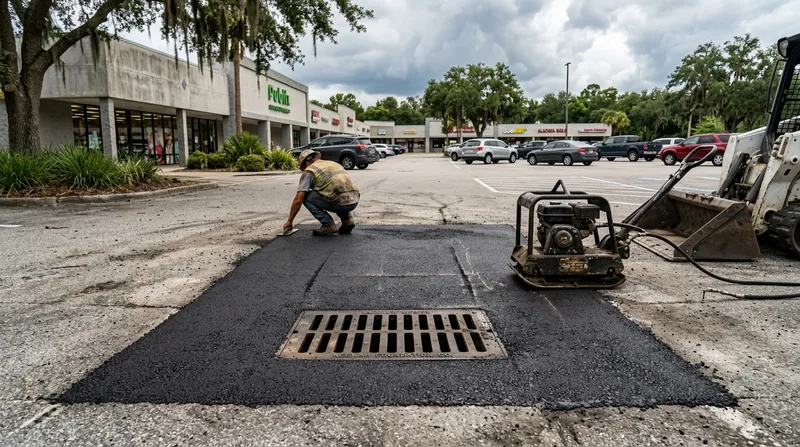




Parking Lot Repair & Resurfacing in Gainesville keeps commercial property managers and HOA boards out of liability court and tenants off the phone. Gainesville's summer thunderstorms and tropical systems like Idalia and Helene wash out parking lot edges, soften bases, and leave standing water that rots asphalt from underneath. The fine sand and clay ground under North Central Florida collects moisture, tree roots from the live oaks and laurel oaks that shade these lots heave the surface, and the heat cycle of 90-degree days and afternoon rain accelerates oxidation. A pothole or failed section is not cosmetic: it is a trip hazard, a liability claim, and a sign the base is failing. We work fast to get the liability off your lot, patch strategically to extend life, and resurface when the pavement tells us it is time.
Why Parking Lot Repair & Resurfacing Matters in Gainesville Commercial Property
Gainesville's commercial corridors along Archer Road, Newberry Road, and Butler Plaza, plus the University of Florida and hospital campuses, all run parking lots that take daily punishment from Florida weather and heavy foot traffic. A failed pothole or section of alligator cracking is not just an eyesore: it exposes your business to slip-and-fall claims, accelerates further base failure, and signals poor maintenance to tenants and customers. Summer thunderstorms deposit 48 inches of rain annually, much of it in afternoon downpours that pond on low spots and seep through cracks. Winter is mild here, but the rare freezes that do arrive can crack already-stressed pavement. Pothole repair and targeted patching stop small failures from becoming expensive base replacements, and an annual maintenance program catches drainage problems before they become tenant complaints.
- Inspect the lot twice a year to catch edge failures and ponding before they spread into the base.
- Patch potholes and failed sections immediately to stop liability exposure and prevent water from weakening the base.
- Clean and grade the perimeter to move standing water away from the asphalt and into proper drainage.
- Resurface when alligator cracking covers more than 30 to 40 percent of the lot, because patching beyond that threshold throws money away.
- Document all work with photos and tonnage specs so your insurance carrier and your board have a record of maintenance.
A documented maintenance program is the clearest proof that your property is well-managed, and it is the cheapest way to extend the life of your lot.
Local example: A 40-space lot in Haile Plantation that was patched annually for three years without resurfacing spent $2,100 on patches that held for six months each. A single resurfacing pass in year four cost $3,800 and bought eight to ten years of life. The lot in the Archer Road retail corridor that was inspected and swept twice a year never needed an emergency repair, and tenants rated the property higher.
Gainesville's municipal code and the Florida Department of Transportation both require that parking lots be maintained to a safe standard. Verify your local permit requirements with the City of Gainesville or your county, especially if your lot touches a drainage structure or a public right-of-way. Gainesville municipal services can clarify what maintenance records you are required to keep.
How We Handle Parking Lot Repair & Resurfacing in Gainesville
We start with an on-site inspection to measure the failed area, probe the base for soft spots, and check drainage. We identify whether the failure is a surface crack that can be sealed, a pothole that needs full-depth patching, or alligator cracking that means the base is compromised and an overlay or full resurfacing is the only durable fix. We give you a written estimate with tonnage, thickness, and scope so you know exactly what you are buying and why. Then we schedule the work around afternoon thunderstorms and traffic patterns so your lot is back in service fast.
- Measure the lot and identify failed sections, soft bases, and drainage problems.
- Write an estimate that specifies tonnage, thickness, and the reason for the method we recommend.
- Remove failed asphalt and probe the base to the depth needed to stop the failure from returning.
- Compact and proof-roll the base so new asphalt will not settle or crack within a year.
- Lay new asphalt to specification and compact it hot so it bonds to the base and does not unravel.
- Sweep the lot and mark the perimeter so tenants see the work is complete and the liability is gone.
We also offer sweeping with any maintenance visit, which keeps debris and standing water from clogging drainage and accelerating failure.
Gainesville example: A 50-space lot near the UF campus had three potholes and a 15-foot section of alligator cracking. We patched the potholes and removed and replaced the cracked section in one day. The base was sound, so no excavation was needed. Total cost was $1,200, the lot was open for business by evening, and the property manager was able to show the board a documented repair with photos and tonnage. See our asphalt resurfacing page for more on when an overlay makes sense.
| Approach | Description | Best for |
|---|---|---|
| Full-depth pothole patch | Remove failed asphalt and base, compact new base material, and lay asphalt to full thickness. | Single potholes and isolated failures where the surrounding base is solid. |
| Partial-depth patch | Remove failed asphalt only, mill the surface smooth, and lay new asphalt over a sound base. | Localized cracking and spalling where the base has not softened. |
| Overlay or resurfacing | Mill the top layer of the existing pavement and lay new asphalt over the compacted surface. | Lots with widespread alligator cracking, oxidation, or minor rutting where the base is still sound. |
| Full-depth replacement | Remove all pavement and base material, rebuild the base with compacted limerock, and lay new asphalt. | Lots with severe base failure, extensive soft spots, or drainage that cannot be fixed without excavation. |
| Storm inlet rebuild | Remove failed asphalt around a drainage inlet, reset the inlet frame and grate, and patch with new asphalt. | Drainage structures that have settled or are surrounded by failed pavement and creating ponding. |
Parking Lot Repair & Resurfacing Cost in Gainesville: What to Expect
Parking lot repair and resurfacing in Gainesville starts at around $650 for a single pothole or small failed section, and scales up based on the size of the failed area, the condition of the base, and whether drainage work is needed. A 50-space lot with two to three potholes and minor edge failure might run $1,200 to $2,500. A full overlay of a 100-space lot typically costs $4,500 to $7,500 depending on the thickness and whether milling is included. A complete replacement with base rebuild can reach $12,000 or more, but that is rare in Gainesville because most lots fail at the surface or base level, not both at once.
The biggest cost drivers are the size of the failed area, the depth of base failure, whether drainage must be rebuilt, and whether the lot can be patched or needs a full resurface. A lot with soft spots and standing water will cost more to repair than a lot with surface cracking only, because the base must be excavated and recompacted. Tree roots from the live oaks and laurel oaks that shade many Gainesville lots can heave the pavement and break the base, which adds cost. Always get two or three written estimates so you can see why one contractor recommends patching and another recommends resurfacing, and ask for tonnage and thickness on every quote so you can compare apples to apples.
For a detailed pricing breakdown and examples of costs for different lot sizes and failure types, see our full pricing overview. Call (352) 450-6164 for a free estimate, and we will measure your lot and give you a number in writing within 24 hours.
What to Look for When Hiring a Parking Lot Paving Contractor Near Gainesville
Hiring an asphalt contractor is a decision that affects your property for a decade or more, and the honest paving shops are easy to separate from the door-to-door crews that move from town to town. A local contractor with a Gainesville address, local phone number, and verifiable references is your first filter. Ask for proof of insurance and check references from other commercial property managers or HOA boards in Gainesville, Alachua, and Newberry who have used the contractor for parking lot work. Get a written estimate that spells out tonnage, thickness, and the reason for the method recommended, not just a price per square foot. Verify that the contractor understands your local permitting requirements, especially if the lot touches a drainage structure or a public right-of-way.
Avoid contractors who show up unsolicited with an offer of leftover asphalt from a nearby job, quote a price on the phone without measuring, ask for a large cash deposit up front, or carry out-of-state plates. Those are the hallmarks of the traveling paving scam that has cost Gainesville property owners thousands. Ask about the contractor's experience with the specific failure you have (pothole, alligator cracking, base failure, drainage), and ask how long they have been in business locally. A contractor in business since 2011 with a local shop and a documented maintenance program to show you is the safest bet.
If your lot is in an HOA or a master-planned community, check your architectural guidelines before you book, because some HOAs require approval for paving work or limit the thickness of an overlay. Gainesville's municipal code may also require a permit for parking lot work, depending on the scope. Call the City of Gainesville or your county building department to verify before you sign a contract, and ask the contractor to help you navigate the permitting process. For a free estimate and references from other Gainesville property managers, contact us here.
Parking Lot Repair & Resurfacing in Gainesville: Pricing Guide
| Service | Price | Details |
|---|---|---|
| Single pothole or small failed section | Starting at $650 | Full-depth removal and patch, includes base inspection and compaction, potholes up to 15 square feet |
| Multiple potholes or localized failure (up to 200 sq ft) | Starting at $1,200 | Two to four potholes or a small failed section, includes base probing and repair, drainage check |
| Lot overlay or resurfacing (1,000 to 5,000 sq ft) | Starting at $3,800 | Includes milling, base inspection, and new asphalt, cost rises with lot size and base condition |
| Full-depth replacement or base rebuild | On estimate | Required when base is soft or lot has severe drainage failure, requires excavation and compaction |
| Free estimate | No charge | On-site measurement, written quote with tonnage and thickness, response within 24 hours |
Indicative pricing, the exact cost depends on square footage, finish, and site access. Free personalized estimate within 24h at (352) 450-6164.


